Parent communication during a school emergency comes down to three pre-drafted messages: an...
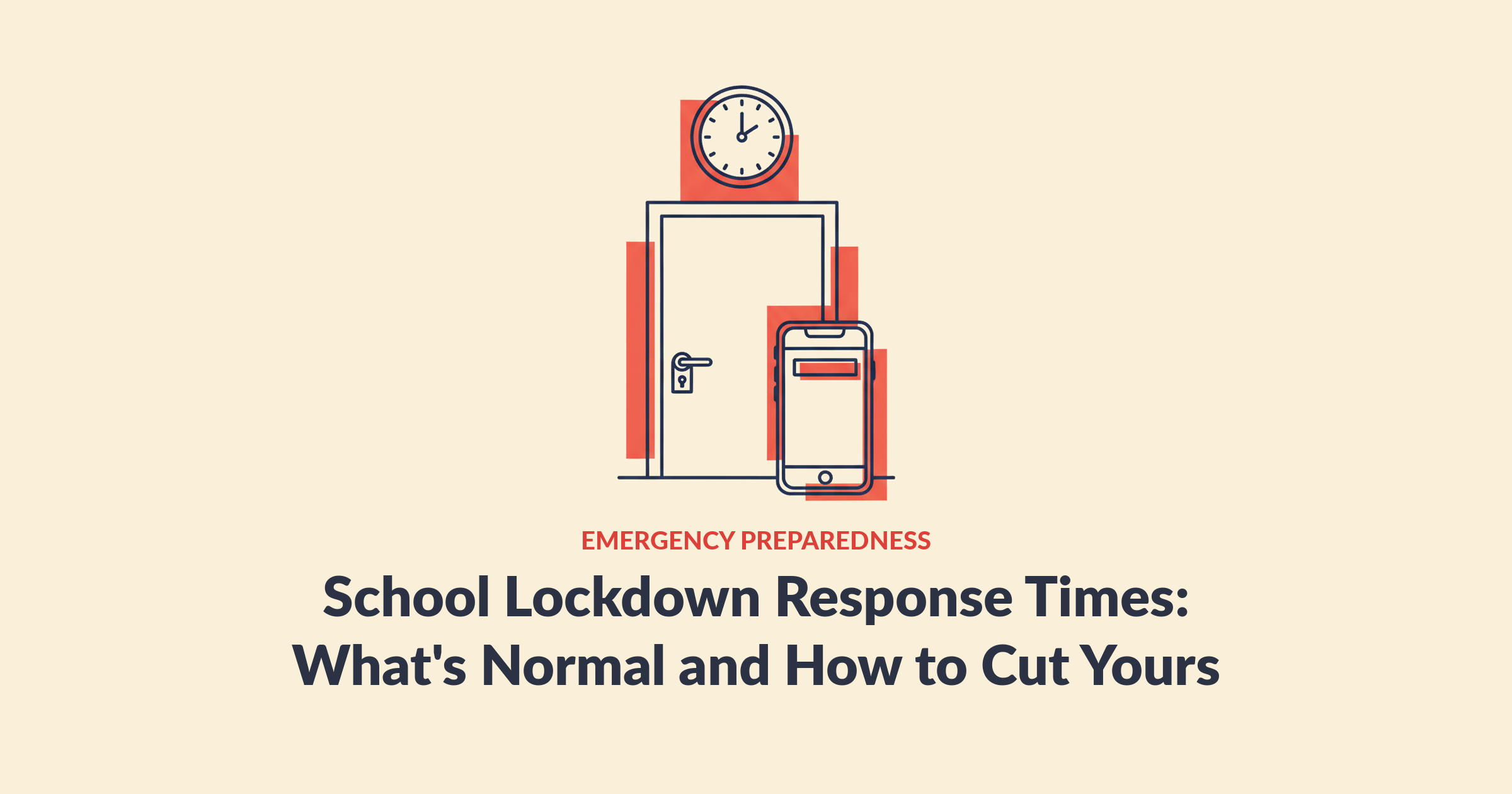
School Lockdown Response Times: What's Normal and How to Cut Yours
A school lockdown response time is the total elapsed time from when a threat is detected to when every room is locked, accounted for, and law enforcement is on scene — and in most districts, the biggest delays are in notification, not police driving time. Districts relying on phone trees and radio relays routinely lose several minutes before responders even know something is happening. Districts with automated alerting have cut law-enforcement notification to 16 seconds.
Quick answer: - Measure the full timeline: detection → alert initiation → staff notification → law-enforcement notification → arrival → room-by-room accountability. - The alert reaching law enforcement takes ~6 minutes on average when it depends on a manual 911 relay; automated systems have done it in 16 seconds. - You can baseline your own response time in one drill with a stopwatch protocol — then attack the slowest phase.
What are the phases of a lockdown timeline?
Every lockdown, real or drilled, moves through six phases — and each one has its own clock. If you only time “how fast doors locked,” you’re measuring one phase out of six. (If your team still debates when to lock down versus shelter, start with lockdown vs. shelter-in-place vs. evacuation.)
| Phase | What happens | Where seconds are lost |
|---|---|---|
| 1. Detection | Someone sees or hears the threat | Hesitation: “Is this real? Who do I tell?” |
| 2. Alert initiation | That person triggers the alert | Finding the office, finding a radio, finding the right app |
| 3. Staff notification | Every adult on campus learns of the lockdown | PA dead zones, modulars, silenced phones, staff outdoors |
| 4. Law-enforcement notification | 911/dispatch learns and responders are en route | Manual relay: someone must remember to call, then describe the building |
| 5. Responder arrival | Officers reach campus and the threat location | Arriving blind — an address, but no floor plan or threat location |
| 6. Accountability | Every room confirms status; missing people identified | Radio roll call, paper rosters, re-checking rooms already cleared |
What’s a normal school lockdown response time?
There’s no single official benchmark for school lockdown response times, but the available evidence points to minutes where seconds are possible. FBI reviews of active-shooter incidents have found median law-enforcement response of roughly three minutes after police are notified — fast by any standard (see the FBI’s active shooter resources). The problem is everything before that: analyses of school incidents suggest total time from incident start to arrival often stretches to ten minutes or more, because notification itself is the longest phase.
That’s the ~6-minute figure school safety planners cite as a national average for an alert reaching law enforcement through manual channels. Against that baseline, Cascade County, Montana — where all 35 county schools run one situational awareness platform — recorded a drill alert reaching law enforcement in 16 seconds. Same phase, same job, minutes versus seconds. External figures vary by study and definition, so treat published averages as directional and your own stopwatch data as truth.
Behind the stopwatch data sits the scenario nobody wants to finish saying out loud. An administrator at a private Los Angeles high school invoked it directly when explaining why his school scrutinizes its own timeline: “if there’s an active shooter, God forbid, ever on this campus…” Every phase in the sections that follow exists to buy back seconds against exactly that sentence.
Where do schools lose the most time?
Schools lose the most time in phases 2 through 4 — the relay problem — and again in phase 6, accountability. The pattern from hundreds of conversations with district safety leaders:
- The relay chain. Teacher tells the office, office gets on the PA, someone dials 911, someone else describes the campus. Every handoff adds thirty seconds to a minute, and any absent link stalls the chain.
- Coverage gaps. The alert fires but doesn’t reach modulars, the ball field, the bus loop, or a silenced phone. Those people respond late or not at all — one small school discovered this when a modular class walked into the building mid-false-alarm, unaware.
- Responders arriving blind. Officers get an address. They don’t get a floor plan, a threat location, or which entrance is safest — so minutes are spent orienting instead of moving.
- Radio roll call. Sixty rooms reporting status one at a time over one channel, while someone tallies on paper. This is routinely the longest phase of a drill, and it’s the phase that answers the only question that matters: is everyone safe?
Detection doesn’t keep school hours, either. A district administrator at a rural California district with five sites described how threats reach her today: a phone call at half past five in the evening, mid-workout at home, about an intimidating stranger on campus — one she had to drive over and chase off herself. When the alert path is one person’s cell phone, every phase downstream waits on that call.
How do notifications, smart maps, and real-time check-ins compress the timeline?
Each phase of the lockdown timeline compresses when you remove a human relay and replace it with simultaneous, automatic communication.
- Phases 2-4 — one tap, everyone at once. Any authorized staff member triggers the lockdown from wherever they’re standing. Staff phones (silent mode overridden), desktops, and displays alert simultaneously — and law enforcement is notified in the same action, not by a separate 911 relay. That’s how a six-minute phase becomes a 16-second one.
- Phase 5 — responders arrive informed. With smart maps, dispatch and arriving officers see floor plans, the threat pin, and safe approaches before they’re out of the vehicle. Twelve states as of mid-2026 have Alyssa’s Law statutes pushing exactly this kind of direct school-to-responder link, with more considering bills.
- Phase 6 — accountability in parallel, not series. Instead of sixty rooms queuing on one radio channel, every teacher marks their room’s status from their own device, and leadership watches a live dashboard: safe, pending, needs help. Digital roll call turns the longest phase into one measured in seconds — so effort goes to finding the three unaccounted-for students, not confirming the 847 safe ones.
This phase-by-phase compression is the specific territory Emergent3 works in — not preventing the incident, but making the sixty seconds after the alert clear instead of chaotic, with no hardware required.
How do you measure your own lockdown response time?
Baseline your lockdown response time in your next scheduled drill with a stopwatch protocol — you need four people, four stopwatches, and one spreadsheet.
- Pick an unannounced initiation point. A designated staff member “detects” the threat at a random location — ideally somewhere hard, like a modular or the field. Their first move starts every clock.
- Timer 1 — alert initiation: stop when the all-staff alert actually fires (not when the initiator starts trying).
- Timer 2 — staff notification: stop when the last staff member confirms receipt. Plant an observer with the hardest-to-reach group. Last, not first — averages hide the person who never got it.
- Timer 3 — law-enforcement notification: stop when dispatch confirms receipt. Coordinate with your SRO or local PD beforehand; most agencies will gladly participate in a timed drill.
- Timer 4 — full accountability: stop when every room’s status is confirmed and any unaccounted-for individuals are named — not when doors are locked.
- Log all four splits and note where the stalls happened. This log doubles as documentation for state drill requirements, and it becomes your after-action report.
Run the same protocol every drill, same measurement points. The trend line matters more than any single run.
What’s on the improvement checklist?
The lockdown improvement checklist starts with your slowest phase and works down. In rough order of impact:
- Give every staff member — not just admin — the ability to initiate an alert in one tap
- Close coverage gaps: modulars, fields, buses, silenced phones, desktops
- Automate law-enforcement notification so it happens with the alert, not after it
- Give responders room-level maps with a threat location, not just an address
- Replace radio roll call with device-based check-ins and a live status dashboard
- Drill with the real system every time — muscle memory beats training binders
- Record splits for all four timers each drill and review them in the after-action
Frequently asked questions
How fast should a school lockdown happen?
Staff notification should complete in under a minute, doors locked within about the same window, and law-enforcement notification should be simultaneous with the alert — seconds, not minutes. Full room-by-room accountability inside a few minutes is achievable with digital check-ins. If any phase takes longer, that’s your improvement target.
What is the average police response time to a school emergency?
FBI analyses put median law-enforcement response around three minutes after notification, but total time from incident start to arrival is often far longer — commonly cited around ten minutes or more — because manual notification eats the difference. That’s why cutting notification time, the phase schools control, has the biggest payoff.
Do lockdown drills actually improve response times?
Yes — when they’re timed. An untimed drill confirms people know the procedure; a timed drill shows you which phase is slow and whether it improved since last quarter. Districts that log splits every drill turn a vague sense of readiness into a falling number they can show the board.
Who should be able to initiate a school lockdown?
Any trained staff member, from wherever they are. If only the front office can trigger a lockdown, phase 2 depends on a relay — and the person who detects a threat is rarely standing in the office. Modern systems handle false-alarm risk with confirmation steps and audit logs, not by bottlenecking initiation.
How does Alyssa’s Law affect lockdown response times?
Alyssa’s Law requires silent panic alarms directly linked to law enforcement — in effect, it mandates compressing phase 4 from minutes to seconds. Twelve states have enacted versions as of mid-2026, with more considering bills. Even outside those states, direct school-to-dispatch alerting is becoming the expected standard.
What should we do after every lockdown drill?
Hold a short after-action review while memory is fresh: the four timer splits, where people hesitated, who never got the alert, and one fix to implement before the next drill. Document it. A season of these reviews typically does more for response time than any single purchase.
Cut the phases you control
You can’t control how far away the nearest patrol car is. You can control whether the alert takes six minutes or sixteen seconds to reach it — and whether accountability takes half an hour of radio traffic or one glance at a dashboard. Baseline your timeline at the next drill, find your slowest phase, and compress it.
E3 compresses phases 2 through 6 in one platform: one-tap alerts that reach every device, automatic responder notification, Smart Maps, and Roll Call in seconds. Book a demo and run your next timed drill on it.