



Skip to content
One platform, every emergency

From the first silent tap to the all-clear, E3 runs the response.

Alert

A silent duress button on every phone that sends a scoped alert in your own code language, so exactly the right staff respond without a word going over the PA.

Check In

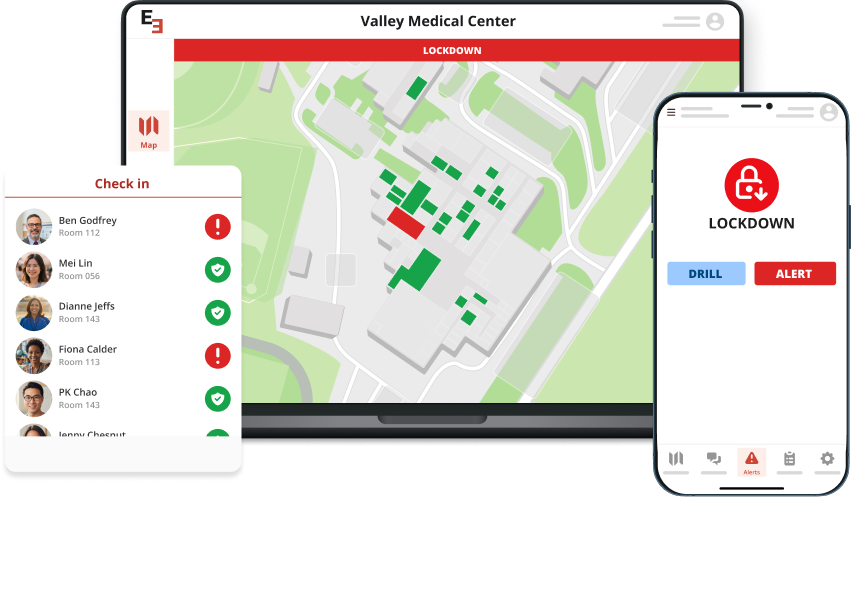
Two taps and every employee reports safe or needs help, with the first check-in landing in about 5.3 seconds and no one walking the halls with a clipboard.

Smart Map

Your floor plans become live maps of who’s safe and who needs help, role-restricted and shared with 911 dispatch so responders see the scene before they arrive.

Chat

Keep the whole response on one thread, charge nurse, security, and responders together, with every message timestamped for the after-action report.
Software UX - Medical
The Current Environment

No industry faces more workplace violence than healthcare.

Ask any charge nurse. The threat isn’t hypothetical: it’s the agitated patient in exam three, the family member who won’t calm down, the ER at 2 a.m.

And the response can be its own risk. Hospitals tell us about codes where too many people came running and made the agitation worse, and overhead pages that alerted everyone, including the patient being de-escalated and the visitors in the lobby.

Your staff need a quiet way to call exactly the right help. And you need the record of what happened without chasing paper for three weeks.

Nearly 3 in 4
workplace violence injuries in U.S. private industry happen in health care and social assistance.
Bureau of Labor Statistics, 2021-2022
5x
healthcare workers are injured by workplace violence at roughly five times the all-industry rate.
Bureau of Labor Statistics
524
U.S. workplace homicides in 2022, the highest in over a decade.
Bureau of Labor Statistics, 2022
The Honest Comparison

The patchwork vs using E3.

Most hospitals run four part-way tools. Here's the day-of difference.

Today's patchwork
Overhead page alerts the whole building, patients included
Call tree and group texts, one person at a time
Paper sign-in sheets and walking the halls to account for staff
After-action reports chased for weeks, 25% come back
Plans in a binder at the bottom of a drawer
Responders arrive blind to a building they've never walked
With E3
Silent, scoped alerts reach exactly the right staff
One tap reaches every employee, every facility, at once
Two-tap check-ins, first one in about 5.3 seconds
Reports generate themselves, timestamped, survey-ready
Plans ride with every alert, on the device staff carry
Responders see the live floor plan before they walk in, free

"We’ve tried different software, but nothing has ever checked all the boxes. And we really feel like this one will.”

Emergency Manager, Idaho critical access hospital (~400 staff)

Hospital FAQs

How is E3 priced?

Per building, not per user. Unlimited staff and devices, free responder access. Most critical access hospitals land between $2,500 and $7,000 per year.

How do hospitals pay for it?

Most hospitals fund it from the operating budget at annual planning, and at this price point it rarely needs board escalation. County-owned and district hospitals route it through the standard budget cycle; we time the quote so your committee has numbers before planning starts.

Can we run our required drills through E3?

Yes. Run fire drills and exercises through E3, without pulling the alarm, and the timestamped record generates as the drill happens: who was alerted, who responded, how fast. Hospitals use these exports for CMS and state survey documentation.

Does the app track employees’ phones?

No. E3 never tracks device location. Check-ins during an event are the only status recorded, and map access is role-restricted.

What about staff who won’t install it on a personal phone?

A fair concern, and E3 was built for it. There is no location tracking, ever; a check-in during an event is the only status recorded. E3 also runs on desktop for nurses’ stations and offices, and units with device restrictions can use shared devices. Most facilities see resistance fade once staff learn the app cannot follow them.

Does E3 replace our codes or clinical messaging?

No. Your code policies stay yours, colors or plain language, and your HIPAA clinical messaging stays for clinical work. E3 is the emergency layer: silent duress, staff accountability, live maps, and the record of what happened.

Do local police, fire, and EMS get access?

Yes, free. Local police, fire, and EMS get instant alerts and live Smart Maps. If the schools in your county use E3, responders may already know the app.

How long does setup take?

Most hospitals are live in a few weeks. Send floor plans; we build the maps and load your emergency operations plan. Training included, for day shift and night shift.

We’re a 13-bed hospital. Is this too much system for us?

E3 runs in 13-bed critical access hospitals and multi-site districts alike. One safety officer can send the alert, watch check-ins land, and pull the report for the survey. Even when you can walk the building, you still have to prove the drill.